
Gutters Sized and Built for Each Specific Roofline
Gutter installation in Gothenburg for homes with undersized, failing, or missing drainage at the roofline
The gutter systems on many older frame homes in Gothenburg were sized for the original roofline and have never been updated to account for additions or outbuildings that increased the roof area draining into them. Short downspout runs that terminate at the foundation, sectional gutters with seams that have opened over years of loading, and undersized five-inch channels on homes with steep or long roof planes are the most common configurations that send water against the structure rather than away from it. 308 Exteriors fabricates and installs seamless gutters on-site in Gothenburg, cutting continuous lengths from aluminum or steel stock to fit each roofline exactly.
The crew measures the roofline first, then runs the fabrication machine on-site to produce gutter lengths without field seams along the run. The only connection points in the finished system are corners and downspout outlets, which are the locations that actually require a joint rather than places where a shorter section ends. Hangers are spaced to support the loaded weight of water and debris rather than at the minimum spacing that satisfies appearance alone, and downspouts are routed to discharge water away from the foundation. Existing gutters are removed and hauled away as part of the installation.
To review your current roofline drainage and receive a documented scope for a new gutter system, call 308 Exteriors at (308) 529-2445 and arrange an on-site measurement.
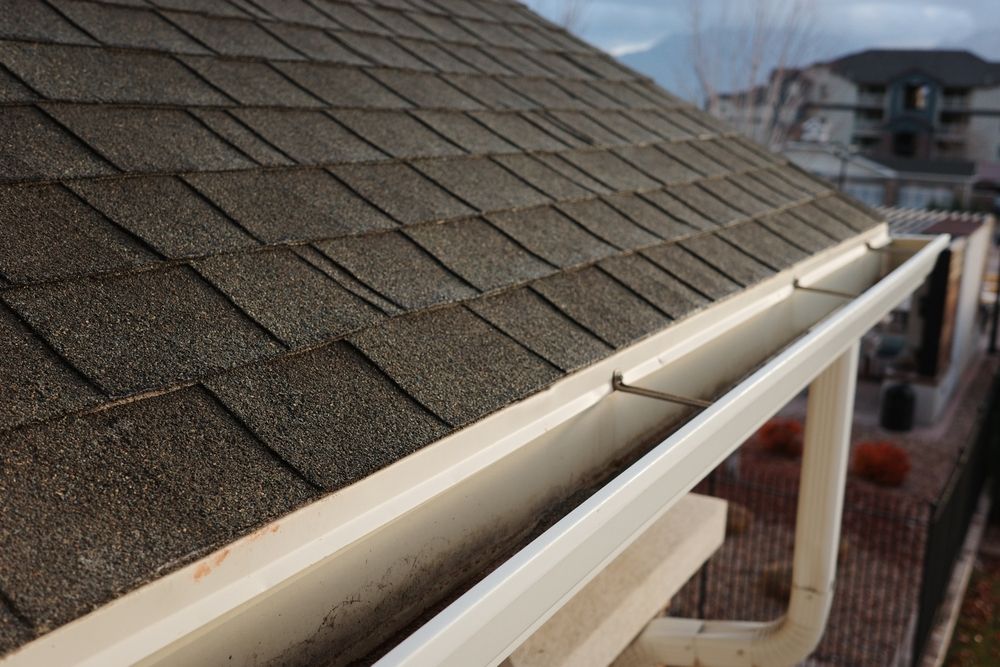
What Proper Seamless Gutter Installation Requires
Seamless fabrication addresses the most common failure point in sectional gutter systems, but the material continuity only performs as intended if the installation itself is correct. Pitch along the gutter run—typically a quarter inch of drop per ten feet of horizontal length—determines whether water moves toward the downspout or pools at low points in the channel. Hanger spacing determines whether the gutter holds its pitch under load or sags over time and reverses it. Both of these factors are set at installation and are not adjustable after the gutter is fastened to the fascia.
After installation, water that previously ran over the top of clogged or undersized gutters, dripped from open seams, or pooled against the foundation now travels the intended path: into the channel, toward the downspout, and away from the structure. On rural farmstead properties with long roof runs and multiple outbuildings, correctly sized gutter sections and downspouts routed to discharge points away from building perimeters are the observable change that makes the difference in how the foundation drains after heavy rain.
Material selection between aluminum and steel is a decision the crew covers during the consultation. Aluminum is lighter and will not rust, making it the standard choice for most residential applications. Steel offers greater rigidity for longer unsupported spans, which comes into play on farmstead structures with wide fascia runs where deflection under loading is a practical consideration. Both options are fabricated on-site and covered by the same 5-year craftsmanship warranty that 308 Exteriors applies to all completed installations.
Questions About How Gutter Installation Works
The questions below focus on what happens during a seamless gutter installation and what the finished system should do. Properties in Gothenburg and the surrounding area range from older in-town frame homes to rural acreages with complex rooflines, and several of these answers reflect conditions specific to those property types.
How is the correct gutter size determined for a specific roofline?
The crew calculates the square footage of each roof plane draining into a given gutter run, then sizes the channel and downspout to handle the volume that plane produces. A five-inch gutter is standard for most residential applications, but longer or steeper roof planes often require a six-inch channel to prevent overflow at peak flow.
What is the difference between on-site fabrication and pre-cut sectional gutters?
On-site fabrication produces a single continuous length from the coil stock, eliminating the seams that appear every ten or twelve feet in a sectional system. Seams in sectional gutters are sealed at installation but open over time as the material expands and contracts, which is the point where most gutter leaks originate.
How are downspouts routed on older Gothenburg homes where foundation clearance is limited?
On homes where the grade has settled against the foundation or where landscaping limits how far a downspout extension can travel, the crew routes the downspout along the wall and adds an elbow and extension that discharges at a point where water moves away from the perimeter rather than draining directly at the base of the wall.
Why does hanger spacing matter beyond what is visible in a finished installation?
Hangers placed at the minimum spacing that satisfies appearance will allow the gutter to deflect under the combined weight of water and debris, which reverses the pitch of the run and creates a low point where standing water collects. Correct spacing holds the channel at the installed pitch through full loading conditions.
What happens to the old gutters as part of a replacement installation?
The existing gutter system is removed in full and hauled from the property as part of the job. The fascia behind the old gutters is checked for rot or deterioration at the fastener points before the new system is attached, since new hangers need solid material to hold pitch and load correctly.
308 Exteriors also installs seamless gutters in Cozad, Kearney, North Platte, and Lexington. To have your roofline measured and a gutter system fabricated specifically for your property, call 308 Exteriors at (308) 529-2445.